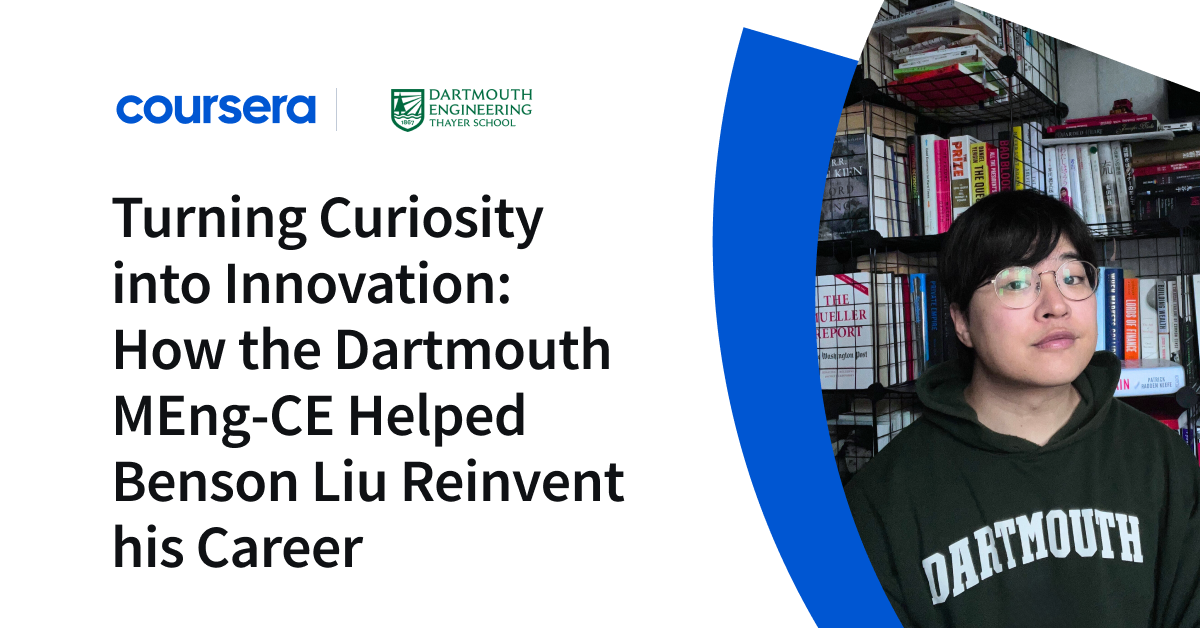

Curiosity has always been Benson Liu’s compass. From earning global credentials to navigating diverse professional fields, he approaches every challenge with a desire to learn and grow. That drive eventually led him to a place where his passions for finance, engineering, and entrepreneurship converged: Dartmouth’s online Master of Engineering in Computer Engineering.
From the moment he discovered Dartmouth’s program, Benson felt an irresistible pull. “We’re the first batch of students. It’s like Forrest Gump’s: ‘life is like a box of chocolates.’ I just had to give it a try!” For Benson, it wasn’t just about earning another degree; it was about “scratching that intellectual curiosity” and building the tools to make a real-world impact.
Born and raised in Australia, Benson Liu also spent much of his childhood in Taiwan and Japan. He completed his undergraduate studies at Osaka University in Japan, specializing in pension finance within economics and stayed on to work there after graduation.
Benson’s early career was firmly rooted in finance. He held M&A finance positions and later earned a master’s degree in finance analytics from King’s College London, a technical degree that reflected the growing demand for quantitative skills in the financial industry. Yet despite his achievements, he felt drawn toward more technical challenges. “I wanted something to help me bridge my finance knowledge with something more technical,” he explains.
This curiosity led him from finance to software engineering and eventually into data science. Over the years, he progressed from junior data scientist to senior roles, and most recently, he took the leap to start his own company, helping clinics and hospitals in Japan develop smarter medical devices.
“The public [medical] sector is huge, but many operate on very old systems. Some hospitals even still use fax machines! My engineering background helps, and my finance background ensures a positive ROI. That’s how the different parts of my experience come together.”
Why another master’s degree?
Benson’s interest in Dartmouth’s MEng in Computer Engineering stemmed from his desire to explore engineering more deeply. A few Coursera courses in mathematics for machine learning had already sparked his interest, and when Dartmouth announced its new master’s program, he decided to give it a try.
Although he entered the program with some background in machine learning, he was unfamiliar with many of the courses. “I was like 30–40% sure of what the program had, so I said, ‘let’s see what the other 60–70% is about.’”
Learning without pausing life
Benson prioritized continuing to grow professionally while pursuing his education. “My career didn’t have to be put on wait. I’ve always enjoyed studying at work. My advantage is that I currently have a lot of freedom, so I wanted to make the most of it. Managing time zones was the only change he had to make because the professors’ office hours for his first subject, Machine Learning, were early in the morning for him in Asia. However, it was manageable due to the program’s flexibility and the Dartmouth teachers’ attentiveness. “Dartmouth teachers are really accommodating.” They typically reply to my emails within five to ten minutes.
Benson has also seen the program’s growing international diversity. In
Why Dartmouth?
Benson didn’t seriously consider other programs. “It was Dartmouth or bust, in very simple terms. But honestly, I didn’t think I’d get accepted. Based on the UK’s education standards, it’s very hard to go from economics to hardcore computer engineering. But Dartmouth is a liberal arts-heavy institution. They like to look at people holistically. So even though I don’t have a formal STEM degree, I have STEM working experience, and they liked the fact that I was well-rounded.”
The program stood out because it blended rigorous engineering training with an appreciation for students’ broader experiences. “There aren’t many programs offering advanced hardware degrees that also value how STEM intersects with fields like finance. It was a perfect match for me.”
A pivot to entrepreneurship
Benson’s ultimate goal has always been entrepreneurship. When asked about his initial goals for pursuing the degree, his answer was clear.
“When I was working for Coca-Cola in Japan, I was fascinated by embedded systems. Interestingly enough, half of Coca-Cola revenue comes from vending machines, which is basically one large embedded system. And vending machines aren’t as simple as putting a coin in and getting a drink anymore. Now it has analytics, dynamic pricing, and automations. Coming into the Dartmouth program, my expectation was to understand the hardware behind these systems.”
However, Benson has since pivoted his reason for pursuing the MEng-CE. As of two months ago, Benson ventured into the realm of entrepreneurship, and he credits his time in the program for giving him the push to finally get started.
Benson’s new company, fueled by his newfound knowledge, develops small, innovative medical devices for the public sector. “A year and a half later, I decided I wanted to build something that benefits society. It’s a bit of a deviation from my original goal, but that’s life.”
Advice for prospective students
In speaking with Benson, he does emphasize the rigor of the coursework. Brushing up on calculus and linear algebra is a must, and the need for time management is critical to balancing study, work, and personal life. When summarizing his advice into three key points, Benson says:
- “This program scratches your intellectual curiosity. Be prepared to work hard, and it will pay off.”
- “Once you’re in, pace yourself. This is a marathon, not a sprint. Keep your mind clear and don’t overdo it. Even as an active learner, this is one of the hardest programs I’ve done. But if you keep a balanced lifestyle, you can do it.”
- “Be active in the community! I attended a Dartmouth event in Japan and met alumni and even got to meet the president of the university. The power of the Dartmouth network is real, even for online students.”
He also emphasizes the relationships he has formed within the program. “I still have weekly conversations with classmates I met in the first module (Machine Learning).” We continue to stay in touch and support one another even after seven courses. There is a human element to this program. We’ve all agreed to get together on campus during graduation, and I’m sure it will be fantastic. I believe it’s reasonable to say that this program has helped me make friends for life.